SR620 frequency counter
Brand:SRS
Name:frequency counter
Model:SR620
Condition:
Delivery Time:5Day
Warranty Period:30Day
Address:China
Whether to Measure:No
$2,216
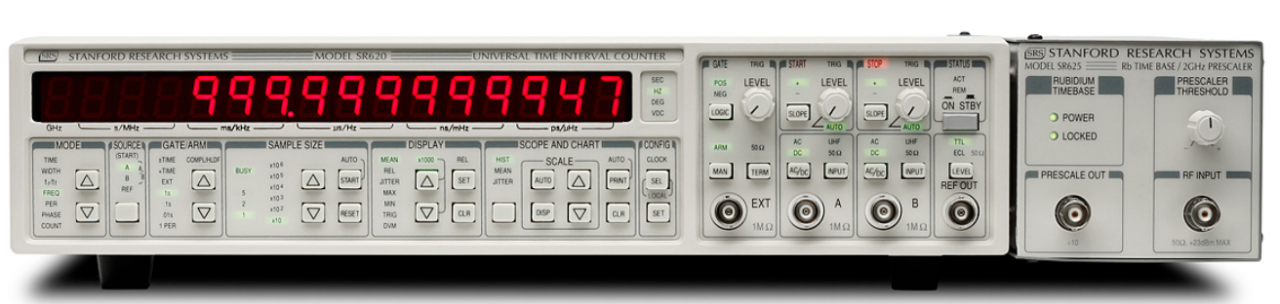
Product Details
DVMs and Analog Outputs
Two rear-panel DVM inputs make measurements of DC voltages with 0.3 % accuracy (±20 VDC range). These values may be read via the interfaces or displayed directly on the front panel.
Two DAC outputs continuously provide voltages proportional to the mean and the jitter of the measurement sample. These 0 to 10 V outputs can drive strip chart recorders, or they can be set to provide fixed or scanned output voltages.
Built-In Auto-Calibration
A sophisticated, built-in auto-calibration routine nulls insertion delays between start and stop channels, and compensates for the differential nonlinearities inherent in analog time-measurement circuitry. The auto-calibration routine takes about two minutes to perform, and should be run every 1000 hours of operation.
10 MHz Reference
The choice of timebase affects both the resolution and accuracy of measurements made with the SR620. SRS offers a choice of a standard timebase with an aging coefficient of 1 × 10⁻⁶/year, or an optional ovenized-oscillator timebase with only 5 × 10⁻¹⁰/day aging, and about an order of magnitude better short-term stability than the standard timebase. A rear-panel input lets you connect any external 5 MHz or 10 MHz source as a timebase.
Computer Interfaces
Standard GPIB (IEEE-488.2) and RS-232 interfaces allow remote control of the SR620. All instrument functions and configuration menu settings are accessible via the interfaces. A fast binary dump mode outputs up to 1400 measurements per second to a computer. A parallel printer port allows direct printing from the instrument. Standard IEEE-488.2 communications are supported, and plotter outputs are provided in HP-GL format. For convenient debugging, the last 256 characters transmitted over the interfaces can be viewed on the front panel.